簡介
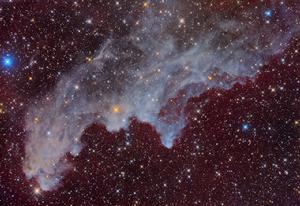
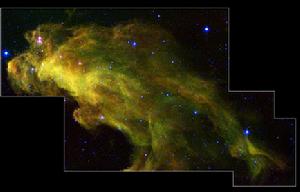
在亮星參宿七的照射下,女巫頭星雲(Witch Head Nebula)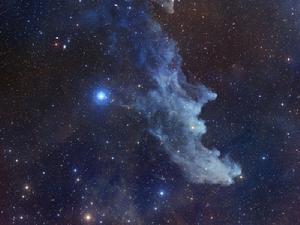
相關
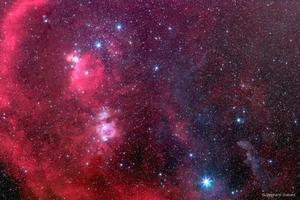
NASA 美國宇航局每日一圖(2008.04.08)Southern Orion: From Belt to Witch
Explanation: Do you recognize the belt of Orion in this image? The familiar trio of stars, visible to the unaided eye, can be found across the upper left. Otherwise, the southern part of the constellation Orion has taken on a new look inthis unusually deep and wide view First note that the lower left belt star, Alnitak, is the easternmost star in Orion's belt. Left of Alnitak is the Flame Nebula, with clouds of bright emission and dramatic dark dust lanes. Directly belowAlnitak, a close inspection will reveal the Horsehead Nebula. Farther right and below is the Orion Nebula, M42, itself visible to the unaided eye. The brightest star in the frame, near the bottom right, is Rigel. A bright blue star, Rigelilluminates the ominously shaped dust patch known as the Witch Head Nebula, visible as the blue reflection nebula near the lower right corner. Finally, appearing as a vast red ring and encompassing the entire region, is Barnard's Loop.Humans could see this entire menagerie, unaided, were their eyes about 10,000 times more sensitive.
獵戶座南方:由腰帶到巫婆星雲
說明:你能在這張影像中找到獵戶座的腰帶在哪兒嗎?這三顆肉眼可見
NASA 美國宇航局每日一圖(2008.11.31)萬聖節(Halloween Night)
By starlight this eerie visage shines in the dark, a crooked profile evoking its popular name, the Witch Head Nebula. In fact, this entrancing telescopic portrait gives the impression the witch has fixed her gaze on Orion's bright supergiant star Rigel. Spanning over 50 light-years, the dusty cosmic cloud strongly reflects nearby Rigel's blue light, giving it the characteristic color of a reflection nebula. Cataloged as IC 2118, the Witch Head Nebula is about 1,000 light-years away. Of course, you might see a witch this scary tonight, but don't panic. Have a safe and Happy Halloween!
說明:在星光下,這一鬼魅的星雲閃爍在黑暗的夜空中,曲折的輪廓讓人想起了它的名
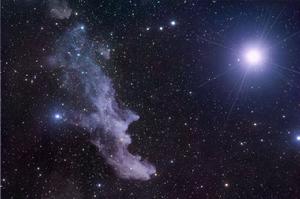
NASA 美國宇航局每日一圖(2009.12.29) Rigel and the Witch Head Nebula
Credit & Copyright: Rogelio Bernal Andreo (Deep Sky Colors)
Explanation: Double, double toil and trouble; Fire burn, and cauldron bubble -- maybe Macbeth should have consulted the Witch Head Nebula. This suggestively shaped reflection nebula on the lower left is associated with the bright star Rigel, to its right, in the constellation Orion. More
formally known as IC 2118, the Witch Head Nebula glows primarily by light reflected from Rigel. Fine dust in the nebula reflects the light. Pictured above, the blue color of the Witch Head Nebula and of the dust surrounding Rigel is caused not only by Rigel's blue color but because the dust grains reflect blue light more efficiently than red. The same physical process causes Earth's daytime sky to appear blue, although the scatterers in Earth's atmosphere are molecules of nitrogen and oxygen. Rigel, the Witch Head Nebula, and gas and dust that surrounds them lie about 800 light-years away.
說明:努力吧!忙碌吧!猛烈的柴火燒煮著沸騰的大鍋—這時候麥克白
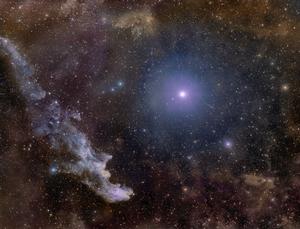
NASA 美國宇航局每日一圖(2012.01.17)
IC 2118: The Witch Head Nebula
Image Credit & Copyright: Gimmi Ratto & Davide Bardini (Collecting Photons)
Explanation: Double, double toil and trouble; Fire burn, and cauldron bubble -- maybe Macbeth should have consulted the Witch Head Nebula. This suggestively shaped reflection nebula is associated with the bright star Rigel in the constellation Orion. More formally known as IC 2118, the Witch Head Nebula glows primarily by light reflected from bright star Rigel, located just below the lower edge of the above image. Fine dust in the nebula reflects the light. The blue color is caused not only by Rigel's blue color but because the dust grains reflect blue light more efficiently than red. The same physical process causes Earth's daytime sky to appear blue, although the scatterers in Earth's atmosphere are molecules of nitrogen and oxygen. The nebula lies about 1000 light-years away.
說明:雙雙而至的圈套及困擾、熊熊烈焰和沸騰的氣泡 - 這一切,也