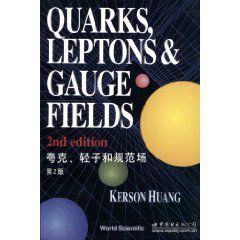
內容簡介
《夸克、輕子和規範場(第2版)》簡明地介紹了在這些思想背後的動力,以及由此而來的嚴謹的數學系統表述。依據通行的觀點,物質的基本徹塊是夸克與輕子,它們通過楊-米爾斯規範場的媒介相互作用(在這種場合下引力被忽略了)。這就意味著相互作用的形式是完全由某些內部對稱群的代數結構所決定的。於是強相互作用是與SU(3)群相關聯的,它是由叫做量子色動力學的規範場理論所描述的。而電一弱相互作用則是與SU(2)XU(1)群相關聯的,現在它是由標準的溫伯格-薩拉姆模型來描述的。
作者簡介
作者:(美國)黃克遜
目錄
PREFACE
Ⅰ.INTRODUCTION
1.1 Particles and Interactions
1.2 Gauge Theories of Interactions
1.3 Notations and Conventions
Ⅱ.QUARKS
2.1 Internal Symmetries
1 Isospin
2 The gauge groups
3 More general internal symmetries: SU(n)
4 Unitary symmetry
2.2 Representation of SU(3)
1 The basic representation
2 Young's tableaux
3irreduciblerepresentations
2.3 TheQuark model
1 Quarks as basic triplets
2 Quarks as building blocks
3 Weight diagrams
4 The composition of hadrons
2.4 Color
1 Independent quark model
2 Color SU(3) group
2.5 Electromagnetic and Weak Probes
1 Electromagnetic interactions
2 Parton model
3 Evidence for color
4 Weak interactions
2.6 Charm
1 The charmed quark
2 The J/φ and its family
3 Correspondence between quarks and leptons
Ⅲ.MAXWELL FIELD: U(I) GAUGE THEORY
3.1 Global and Local Gauge Invariance
3.2 Spontaneous Breaking of Global Gauge Invariance: Goldstone Mode
3.3 Spontaneous Breaking of Local Gauge Invariance: Higgs Mode
3.4 Classical Finite-Energy Solutions
3.5 Magnetic Flux Quantization
3.6 Soliton Solutions: Vortex Lines
Ⅳ. YANG-MILLS FIELDS: NON-ABELIAN GAUGE THEORIES
4.1 Introductory Note
4.2 Lie Groups
1 Structure constants
2 Matrix representations
3 Topological properties
4 General remarks
4.3 The Yang-Mills Constructions
1 Global gauge invariance
2 Local gauge invariance
4.4 Properties of Yang-Milis Fields
1 Electric and magnetic fields
2 Dual tensor
3 Path representation of the gauge group
4.5 Canonicalformalism
1 Equations of motion
2 Hamiltonian
4.6 Spontaneous Symmetry Breaking
1 The little group
2 Higgs mechanism
Ⅴ.TOPOLOGICAL SOLITONS
5.1 Solitons
5.2 The Instanton
1 Topological charge
2 Explicit solution
5.3 The Monopole
1 Topological stability
2 Flux quantization
3 Boundary conditions
4 Explicit solution
5 Physical fields
6 Spin from isospin
Ⅵ.WEINBERG-SALAM MODEL
6.1 The Matter Fields
6.2 The Gauge Fields
1 Gauging SU(2)×U(1)
2 Determination of constants
3 Interactions
6.3 The General Theory
1 Mass terms
2 Cabibbo angle
3 Kobayashi-Maskawa matrix
4 Solitons
Ⅶ.METHOD OF PATH INTEGRALS
7.1 Non-Relativistic Quantum Mechanics
7.2 Quantum Field Theory
7.3 External Sources
7.4 Euclidean 4-Space
7.5 Calculation of Path Integrals
7.6 The Feynman .propagator
7.7 Feynman Graphs
7.9 Fermion Fields
Ⅷ.QUANTIZATION OF GAUGE FIELDS
8.1 Canonical Quantization
1 Free Maxwell field
2 Pure Yang-Mills fields
8.2 Path Integral Method in Hamiltonian Form
8.3 Feynman Path Integral: Fadeev-Popov Method
8.4 Free Maxwell Field
1 Lorentz gauge
2 Coulomb gauge
3 Temporal and axial gauges
8.5 Pure Yang-Mills Fields
I Axial gauge
2 Lorentz gauge: Fadeev-Popov ghosts
8.6 The 0-World and the Instanton
1 Discovering the 0-world
2 lnstanton as tunneling solution
3 The 0-action
8.7 Gribov Ambiguity
8.8 Projection Operator for Gauss' Law
Ⅸ.RENORMALIZATION
9.1 Charge Renormalization
9.2 Perturbative Renormalization in Quantum Electredynamics
9.3 The Renormalization Group
1 Scale transformations
2 Scaling form
3 Fixed points
4 Callan-Symanzik equation
9.4 Scalar Fields
1 Renormalizability
2 Φ4 theory
3 "Triviality" and the Landau ghost
9.5 The Physics of Renormalization
1 Renormalization-group transformation
2 Real-space renormalization
3 Fixed points and relevancy
4 Renormalization and universality
Appendix to Chapter 9. Renormalization ofQED
1 Vertex
2 Electron Propagator
3 Photon Propagator
4 Scaling Properties
5 Renormalization
6 Gauge Invariance and the Photon Mass
Ⅹ.METHOD OF EFFECTIVE POTENTIAL
10.1 Spontaneous Symmetry Breaking
10.2 The Effective Action
10.3 The Effective Potential
10.4 The Loop Expansion
10.5 One-Loop Effective Potential
10.6 Renormalization
1 General scheme
2 Massive case
3 Massless case
10.7 Dimensionaltransmutation
10.8 A Non-Relativistic Example
10.9 Application to Weinberg-Salam Model
Ⅺ. THE AXIAL ANOMALY
11.1 Origin of the Axial Anomaly
11.2 The Triangle Graph
11.3 Anomalous Divergence of the Chiral Current
11.4 Physical Explanation of the Axial Anomaly
11.5 Cancellation of Anomalies
11.6 't Hooft's Principle
Ⅻ. QUANTUM CHROMODYNAMICS
12.1 General Properties
1 Lagrangian density
2 Feynman rules
3 Quark-gluon interactions
4 Gluon self-interactions
12.2 The Color Gyromagnetic Ratio
12.3 Asymptotic Freedom
1 The running coupling constant
2 The vacuum as magnetic medium
3 The Nielsen-Hughes formula
12.4 Thepionas Goldstone Boson
1 The low-energy domain
2 Chiral symmetry: an idealized limit
3 PCAC
4 The decay π0→2y
5 Extension to pion octet
12.5 The U(1) Puzzle
12.6 θ-Worlds in QCD
1 Euclidean action
2 The axial anomaly and the index theorem
3 Chiral limit: Collapse of the 0-worlds
4 Quark mass matrix
5 Strong CP violation
ⅩⅢ. LATTICE GAUGE THEORY
13.1 Wilson's Lattice Action
13.2 Transfer Matrix
13.3 Lattice Hamiltonian
13.4 Lattice Fermions
13.5 Wilson Loop and Confinement
13.6 Continuum Limit
13.7 Monte Carlo Methods
ⅩⅣ. QUARK CONFINEMENT
14.1 Wilson Criterion and Electric Confmement
14.2 String Model of Hadrons
14.3 Superconductivity: Magnetic Confinement
1 Experimental manifestation
2 Theory
3 Mechanism for monopole confinement
14.4 Electric and Magnetic Order Parameters
14.5 Scenario for Quark Confinement
Appendix to Chapter 14.Symmetry and Confinement
1 Quark Propagator
2 Center Symmetry
3 Confinement as Symmetry
INDEX
