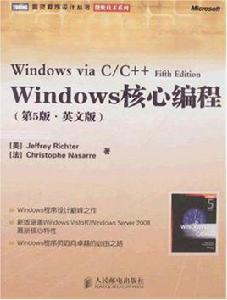
版權資訊
書 名: Windows核心編程(英文版)
作 者:(美國)里克特
出版社: 人民郵電出版社
出版時間: 2008
ISBN: 9787115182128
開本: 16
定價: 128.00 元
內容簡介
《Windows核心編程(第5版·英文版)》適於各層次Windows編程人員閱讀。
作者簡介
JeffreyRichter全球享有盛譽的微軟技術專家,著名技術諮詢和培訓公司Wintellect創始人之一,MSDNMagazine雜誌特邀編輯。多年來,他擔任微軟各開發團隊顧問,參與了微軟的許多關鍵產品包括各版本Windows、VisualStudio、MicrosoftOffce和.NET框架的設計和編程。他撰寫了一系列著作,包括本書和《深入理解.NET》(第2版·英文版,人民郵電出版社。2008),都堪稱技術圖書的典範,影響了一代Windows程式設計師,並因此榮獲微軟公司杜區最高技術榮譽“微軟軟體傳奇人物”(SoftwareLegend)稱號。
編輯推薦
Windows程式設計巔峰之作,新版涵蓋WindowsVista和WindowsServer2008最新核心特性,Windows程式設計師邁向卓越的必由之路。
《Windows核心編程(第5版·英文版)》是Windows程式設計領域廣受推崇的聖經級著作。書中深入剖析了Windows程式設計師必須掌握的底層實現機理,通過大量貼近實戰、精心編寫的代碼,詳細闡述了Windows的各種基本要素。如字元和字元串、核心對象、進程、作業、執行緒、纖程、記憶體管理、DLL和異常處理等。
新版做了較大幅度的更新。一些章節(如第11章)全面重寫。其他章節也有重要修訂,以涵蓋Windows最新版本(WindowsVista和WindowsServer2008)的核心特性。支持64位Windows。代碼主要用C++進行了全面改寫,更加簡明易懂。
目錄
Part IRequired Reading
1Error Handling
Defining Your Own Error Codes
The ErrorShow Sample Application
2Working with Characters and Strings
Character Encodings
ANSI and Unicode Character and String Data Types
Unicode and ANSI Functions in Windows
Unicode and ANSI Functions in the C Run-Time Library
Secure String Functions in the C Run-Time Library
Introducing the New Secure String Functions
How to Get More Control When Performing String Operations
Windows String Functions
Why You Should Use Unicode
How We Recommend Working with Characters and Strings
Translating Strings Between Unicode and ANSI
Exporting ANSI and Unicode DLL Functions
Determining If Text Is ANSI or Unicode
3Kernel Objects
What Is a Kernel Object?
Usage Counting
Security
A Process' Kernel Object Handle Table
Creating a Kernel Object
Closing a Kernel Object
Sharing Kernel Objects Across Process Boundaries
Using Object Handle Inheritance
Naming Objects
Duplicating Object Handles
Part IIGetting Work Done
4Processes
Writing Your First Windows Application
A Process Instance Handle
The CreateProcess Function
pszApplicationName and pszCommandLine
Terminating a Process
The Primary Thread's Entry-Point Function Returns
The ExitProcess Function
The TerminateProcess Function
When All the Threads in the Process Die
When a Process Terminates
Child Processes
Running Detached Child Processes
When Administrator Runs as a Standard User
Elevating a Process Automatically
Elevating a Process by Hand
What Is the Current Privileges Context?
Enumerating the Processes Running in the System
5Jobs
Placing Restrictions on a Job's Processes
Placing a Process in a Job
Terminating All Processes in a Job Querying Job Statistics
Job Notifications
The Job Lab Sample Application
6Thread Basics
When to Create a Thread
When Not to Create a Thread
Writing Your First Thread Function
The CreateThread Function
psa
cbStackSize
pfnStartAddr and pvParam
dwCreateFlags
pdwThreadID
Terminating a Thread
The Thread Function Returns
The ExitThread Function
The TerminateThread Function
When a Process Terminates
When a Thread Terminates
Some Thread Internals
C/C++ Run-Time Library Considerations
Oops-I Called CreateThread Instead of _beginthreadex by Mistake
C/C++ Run-Time Library Functions That You Should Never Call
Gaining a Sense of One's Own Identity
Converting a Pseudohandle to a Real Handle
7Thread Scheduling, Priorities, and Affinities
Suspending and Resuming a Thread
Suspending and Resuming a Process
Sleeping
Switching to Another Thread
Switching to Another Thread on a Hyper-Threaded CPU
A Thread's Execution Times
Putting the CONTEXT in Context
Thread Priorities
An Abstract View of Priorities
Programming Priorities
Dynamically Boosting Thread Priority Levels
Tweaking the Scheduler for the Foreground Process
Scheduling I/O Request Priorities
The Scheduling Lab Sample Application
Affinities
8Thread Synchronization in User Mode
Atomic Access: The Interlocked Family of Functions
Cache Lines
Advanced Thread Synchronization
A Technique to Avoid
Critical Sections
Critical Sections: The Fine Print
Critical Sections and Spinlocks
Critical Sections and Error Handling
Slim Reader-Writer Locks
Condition Variables
The Queue Sample Application
Useful Tips and Techniques
9Thread Synchronization with Kernel Objects
Wait Functions
Successful Wait Side Effects
Event Kernel Objects
The Handshake Sample Application
Waitable Timer Kernel Objects
Having Waitable Timers Queue APC Entries
Timer Loose Ends
Semaphore Kernel Objects
Mutex Kernel Objects
Abandonment Issues
Mutexes vsCritical Sections
The Queue Sample Application
A Handy Thread Synchronization Object Chart
Other Thread Synchronization Functions
Asynchronous Device I/O
WaitForInputIdle
MsgWaitForMultipleObjects(Ex)
WaitForDebugEvent
SignalObjectAndWait
Detecting Deadlocks with the Wait Chain Traversal API
10Synchronous and Asynchronous Device I/O
Opening and Closing Devices
A Detailed Look at CreateFile
Working with File Devices
Getting a File's Size
Positioning a File Pointer
Setting the End of a File
Performing Synchronous Device I/O
Flushing Data to the Device
Synchronous I/O Cancellation
Basics of Asynchronous Device I/O
The OVERLAPPED Structure
Asynchronous Device I/O Caveats
Canceling Queued Device I/O Requests
Receiving Completed I/O Request Notifications
Signaling a Device Kernel Object
Signaling an Event Kernel Object
Alertable I/O
I/O Completion Ports
11 The Windows Thread Pool
Scenario 1: Call a Function Asynchronously
Explicitly Controlling a Work Item
The Batch Sample Application
Scenario 2: Call a Function at a Timed Interval
The Timed Message Box Sample Application
Scenario 3: Call a Function When a Single Kernel Object Becomes Signaled
Scenario 4: Call a Function When Asynchronous I/O Requests Complete
Callback Termination Actions
Customized Thread Pools
Gracefully Destroying a Thread Pool: Cleanup Groups
12Fibers
Working with Fibers
The Counter Sample Application
Part IIIMemory Management
13Windows Memory Architecture
A Process' Virtual Address Space
How a Virtual Address Space Is Partitioned
Null-Pointer Assignment Partition
User-Mode Partition
Kernel-Mode Partition
Regions in an Address Space
Committing Physical Storage Within a Region
Physical Storage and the Paging File
Physical Storage Not Maintained in the Paging File
Protection Attributes
Copy-on-Write Access
Special Access Protection Attribute Flags
Bringing It All Home
Inside the Regions
The Importance of Data Alignment
14Exploring Virtual Memory
System Information
The System Information Sample Application
Virtual Memory Status
Memory Management on NUMA Machines
The Virtual Memory Status Sample Application
Determining the State of an Address Space
The VMQuery Function
The Virtual Memory Map Sample Application
15Using Virtual Memory in Your Own Applications
Reserving a Region in an Address Space
Committing Storage in a Reserved Region
Reserving a Region and Committing Storage Simultaneously
When to Commit Physical Storage
Decommitting Physical Storage and Releasing a Region
When to Decommit Physical Storage
The Virtual Memory Allocation Sample Application
Changing Protection Attributes
Resetting the Contents of Physical Storage
The MemReset Sample Application
Address Windowing Extensions
The AWE Sample Application
16A Thread's Stack
The C/C++ Run-Time Library's Stack-Checking Function
The Summation Sample Application
17Memory-Mapped Files
Memory-Mapped Executables and DLLs
Static Data Is Not Shared by Multiple Instances of an Executable or a DLL
Memory-Mapped Data Files
Method 1: One File, One Buffer
Method 2: Two Files, One Buffer
Method 3: One File, Two Buffers
Method 4: One File, Zero Buffers
Using Memory-Mapped Files
Step 1: Creating or Opening a File Kernel Object
Step 2: Creating a File-Mapping Kernel Object
Step 3: Mapping the File's Data into the Process' Address Space
Step 4: Unmapping the File's Data from the Process' Address Space
Steps 5and 6: Closing the File-Mapping Object and the File Object
The File Reverse Sample Application
Processing a Big File Using Memory-Mapped Files
Memory-Mapped Files and Coherence
Specifying the Base Address of a Memory-Mapped File
Implementation Details of Memory-Mapped Files
Using Memory-Mapped Files to Share Data Among Processes
Memory-Mapped Files Backed by the Paging File
The Memory-Mapped File Sharing Sample Application
Sparsely Committed Memory-Mapped Files
The Sparse Memory-Mapped File Sample Application
18Heaps
A Process' Default Heap
Reasons to Create Additional Heaps
Component Protection
More Efficient Memory Management
Local Access
Avoiding Thread Synchronization Overhead
Quick Free
How to Create an Additional Heap
Allocating a Block of Memory from a Heap
Changing the Size of a Block
Obtaining the Size of a Block
Freeing a Block
Destroying a Heap
Using Heaps with C++
Miscellaneous Heap Functions
Part IVDynamic-Link Libraries
19DLL Basics
DLLs and a Process' Address Space
The Overall Picture
Building the DLL Module
Building the Executable Module
Running the Executable Module
20DLL Advanced Techniques
Explicit DLL Module Loading and Symbol Linking
Explicitly Loading the DLL Module
Explicitly Unloading the DLL Module
Explicitly Linking to an Exported Symbol
The DLL's Entry-Point Function
The DLL_PROCESS_ATTACH Notification
The DLL_PROCESS_DETACH Notification
The DLL_THREAD_ATTACH Notification
The DLL_THREAD_DETACH Notification
Serialized Calls to DllMain
DllMain and the C/C++ Run-Time Library
Delay-Loading a DLL
The DelayLoadApp Sample Application
Function Forwarders
Known DLLs
DLL Redirection
Rebasing Modules
Binding Modules
21Thread-Local Storage
Dynamic TLS
Using Dynamic TLS
Static TLS
22DLL Injection and API Hooking
DLL Injection: An Example
Injecting a DLL Using the Registry
Injecting a DLL Using Windows Hooks
The Desktop Item Position Saver (DIPS) Utility
Injecting a DLL Using Remote Threads
The Inject Library Sample Application
The Image Walk DLL
Injecting a DLL with a Trojan DLL
Injecting a DLL as a Debugger
Injecting Code with CreateProcess
API Hooking: An Example
API Hooking by Overwriting Code
API Hooking by Manipulating a Module's Import Section
The Last MessageBox Info Sample Application
Part VStructured Exception Handling
23Termination Handlers
Understanding Termination Handlers by Example
Funcenstein1
Funcenstein2
Funcenstein3
Funcfurter1
Pop Quiz Time: FuncaDoodleDoo
Funcenstein4
Funcarama1
Funcarama2
Funcarama3
Funcarama4: The Final Frontier
Notes About the finally Block
Funcfurter2
The SEH Termination Sample Application
24Exception Handlers and Software Exceptions
Understanding Exception Filters and Exception Handlers by Example
Funcmeister1
Funcmeister2
EXCEPTION_EXECUTE_HANDLER
Some Useful Examples
Global Unwinds
Halting Global Unwinds
EXCEPTION_CONTINUE_EXECUTION
Use EXCEPTION_CONTINUE_EXECUTION with Caution
EXCEPTION_CONTINUE_SEARCH
GetExceptionCode
Memory-Related Exceptions
Exception-Related Exceptions
Debugging-Related Exceptions
Integer-Related Exceptions
Floating Point-Related Exceptions
GetExceptionInformation
Software Exceptions
25Unhandled Exceptions, Vectored Exception Handling, and C++ Exceptions
Inside the UnhandledExceptionFilter Function
Action #1: Allowing Write Access to a Resource and Continuing Execution
Action #2: Notifying a Debugger of the Unhandled Exception
Action #3: Notifying Your Globally Set Filter Function
Action #4: Notifying a Debugger of the Unhandled Exception (Again)
Action #5: Silently Terminating the Process
UnhandledExceptionFilter and WER Interactions
Just-in-Time Debugging
The Spreadsheet Sample Application
Vectored Exception and Continue Handlers
C++ Exceptions vsStructured Exceptions
Exceptions and the Debugger
26Error Reporting and Application Recovery
The Windows Error Reporting Console
Programmatic Windows Error Reporting
Disabling Report Generation and Sending
Customizing All Problem Reports Within a Process
Creating and Customizing a Problem Report
Creating a Custom Problem Report: WerReportCreate
Setting Report Parameters: WerReportSetParameter
Adding a Minidump File to the Report: WerReportAddDump
Adding Arbitrary Files to the Report: WerReportAddFile
Modifying Dialog Box Strings: WerReportSetUIOption
Submitting a Problem Report: WerReportSubmit
Closing a Problem Report: WerReportCloseHandle
The Customized WER Sample Application
Automatic Application Restart and Recovery
Automatic Application Restart
Support for Application Recovery
Part VIAppendixes
AThe Build Environment
The CmnHdr.h Header File
Microsoft Windows Version Build Option
Unicode Build Option
Windows Definitions and Warning Level 4
The pragma message Helper Macro
The chINRANGE Macro
The chBEGINTHREADEX Macro
DebugBreak Improvement for x86Platforms
Creating Software Exception Codes
The chMB Macro
The chASSERT and chVERIFY Macros
The chHANDLE_DLGMSG Macro
The chSETDLGICONS Macro
Forcing the Linker to Look for a (w)WinMain Entry-Point Function
Support XP-Theming of the User Interface with pragma
BMessage Crackers, Child Control Macros, and API Macros
Message Crackers
Child Control Macros
API Macros
Index
……
